
The Mantilla
The Legacy Continues: Tradition and Future
The future of the mantilla
After decades of unwavering dedication to the art of embroidery, Encarnita Berrio has decided to take a natural and hopeful step: passing the torch to her children. This generational shift ensures that the essence, design, and soul of the brand will remain alive, as they assume the management of production with the same commitment and respect for the craft that their mother, and before her, their grandmother, instilled in them.
Although our core identity and primary activity will always remain hand embroidery , we are aware of the current challenges. The scarcity of professional embroiderers and the high cost of production—stemming from the precious materials and the countless hours of labor—make these pieces rare and hard-to-find treasures.
With the aim of making the beauty of the mantilla accessible to everyone without compromising on quality, thus preserving its designs, a new generation has emerged, launching a machine-based production line . This decision follows a meticulous selection of advanced technology, choosing only the type of machinery that offers the most faithful and delicate results in keeping with the traditional aesthetic.
A fight for living craftsmanship
This change doesn’t mean goodbye to craftsmanship; on the contrary, it’s a way to protect it. Encarnita Berrio will continue her tireless fight to promote the value of hand embroidery.
From his new position, he will continue to actively fight for:
- Promote formal education provided by qualified teachers.
- To obtain incentives and institutional support that protect this cultural heritage.
- To ensure that this type of craftsmanship, unique in the world, not only does not decline, but also regains the prestige and viability it deserves.
In this new stage, Encarnita Berrio’s workshop unites its roots with the future, maintaining its usual elegance but opening its doors to a new generation of women who wish to showcase the essence of Granada.


History of the Spanish Mantilla
Making the Mantilla
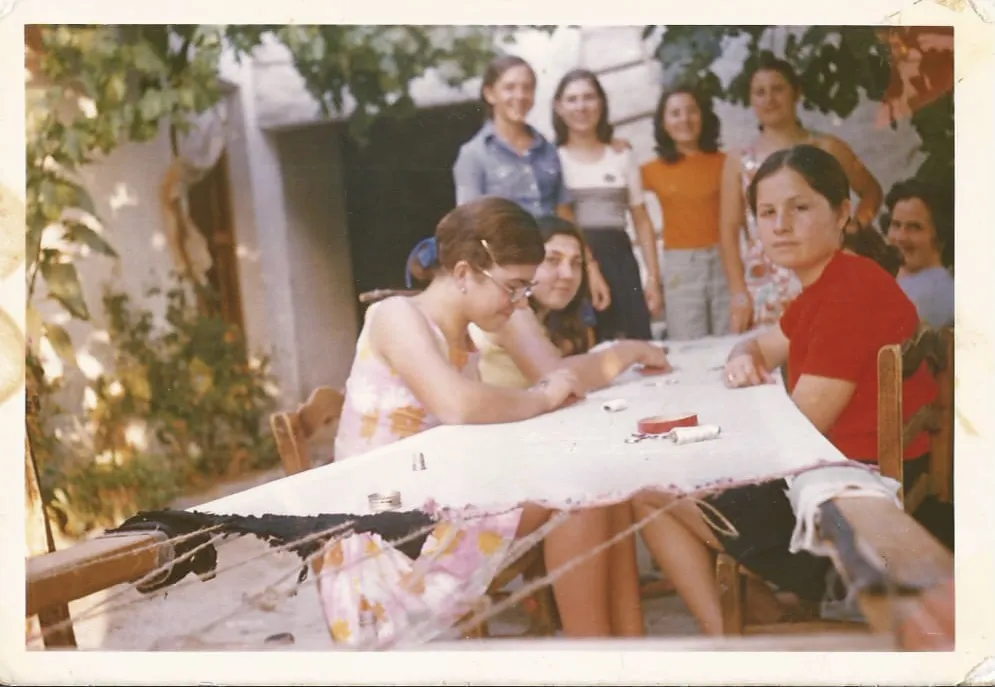
At the end of the 18th century, with the invention of mechanical tulle, embroidery on tulle began to emerge; at the beginning of the 20th century, the first workshops began to be organized in Granada.
The oldest tulle designs feature intricate, dense decoration, and some include the pomegranate motif. Over time, the motifs became larger and more dispersed, inspired by the Nasrid ornamentation of the Alhambra. This craft would later become better known as Granada lace.
Today, this workshop continues to use the same embroidery technique, creating unique pieces as it is a handcrafted work, pieces that can be customized at the customer’s request.
If we talk about the history of the mantilla in the last 50 years, we have to talk about Encarna Berrio with an indisputable presence in the world of mantillas and embroidery.
Encarna Berrio was born into a family heritage and tradition that, since the beginning of the century, has been characterized by the combination of pure and traditional craftsmanship with contemporary innovation.
She has managed to create her own timeless and personalized style with great success both nationally and internationally.
The Mantilla
The art of the mantilla and it´s uses is for Encarna Berrio a real inner need that is reflected in all her creations.
Creations who discover a woman who must shine and be shown to all and foremost. This is a woman who appears calm, intimacy, depth and wisdom.
A woman does not lose the balance between improvisation and premeditation.
A woman whose eyes show the essence of the magic sense of femininity and elegance in its purest form.
Protocol throughout the History of the Spanish Mantilla
Mantillas are a garment of Spanish tradition, an evolution of the old veil that women wore to attend religious celebrations.
Its origins, though unclear, can be traced back to Iberian culture, where its function was to protect against the cold . Its evolution was influenced by various social, religious, and even climatic factors, but it wasn’t until the beginning of the 16th century that its use became widespread, transforming it into a fundamental ornamental piece in women’s clothing, crafted with lace. By the 19th century, it had become a symbol of Spanish womanhood, thanks to the efforts of Queen Isabella II.
Currently, the Spanish mantilla is an indispensable piece at weddings and bullfights, and according to tradition and protocol, the white or ivory mantilla is for single women, and the black one for married women.
According to protocol, to wear a mantilla, it is essential to accompany it with a good comb, but if you are accompanied, you must keep in mind its height as well as ours.
The mantilla should be appropriate for the wearer’s height, without exceeding the length of the skirt. In the front, it should reach the hands, and in the back, slightly below the hips.
At weddings, the godmother, if the ceremony is during the day, should wear a short dress, and if it is in the afternoon or evening, a long dress. As for the guests, they can opt for the so-called «picos,» smaller in size but of equal quality.
Finally, the protagonists of weddings, the brides, have it very easy with the color, white or ivory, but in addition to the traditional option of the mantilla they can opt for bridal veils, with more length and distinction.